

Introduction
Agentic AI is one of the most critical advancements in the quickly evolving field of artificial intelligence (AI). This system can make autonomous decisions, adapt situationally, and gradually improve. Agentic AI may analyze data, learn from previous experiences, and operate without continuous human supervision. From AI-powered solutions in business automation, healthcare, and finance to self-learning AI models that enhance decision-making, this technology is transforming a number of industries. But massive authority also comes with responsibility. To avoid biases and preserve transparency, ethical AI procedures and systems of governance are essential.
This blog will discuss the future of autonomous AI decision-making, its difficulties, and how agentic AI is changing industries.
What is Agentic AI?
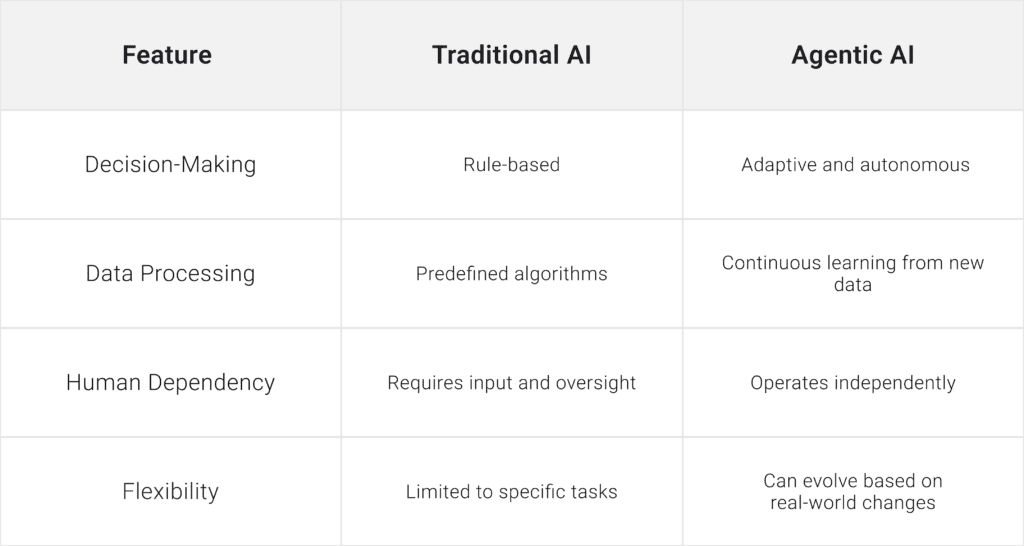
Artificial intelligence systems that understand, make decisions and act independently according to the environment are called agentic AI. In contrast with traditional AI, which depends on inputs defined by humans, agentic AI uses:
- Adaptive Learning: It uses real-time data to update its decision-making models continuously.
- Independence: After installation, little to no human involvement is needed.
- Advanced Thinking: It can analyze several variables for the most appropriate action plan.
Agentic AI, for instance, is used by self-driving cars to evaluate road conditions, anticipate the actions of other drivers, and make immediate choices without exclusively depending on pre-programmed rules.
1- Key Characteristics of Agentic AI
With its ability to function autonomously, be experience-based, and make decisions, agentic AI sets the standard for artificial intelligence as it develops further. In contrast to traditional AI, which adheres to strict programming guidelines, agentic AI can assess situations, adapt to unexpected challenges, and improve gradually. Some prominent features that make it revolutionary in today’s technology are listed below.
1. Autonomous Decision-Making
Making Decisions on Your Own
Instead of waiting for human direction, it can assess situations, analyze data, and react to what it has learned.
For example, AI-powered automated trading systems in the financial sector employ real-time market data to make quick purchasing or selling choices without requiring human involvement.
AI systems can function independently, making them more effective, responsive, and scalable across industries.
2. Adaptive Learning (Self-Improvement Over Time)
Traditional AI systems need regular upgrades and human involvement to be more effective. In contrast, agentic AI continuously improves its decision-making process by learning from its own experiences.
How it works:
- Collects and analyzes data from past actions.
- Identifies patterns and adjusts strategies.
- Improves accuracy and efficiency without manual reprogramming.
For Example, Self-learning AI models in healthcare analyze patient data over time to make better therapy recommendations and earlier disease predictions.
Because of its capacity for learning, adaptation, and evolution, agentic AI is incredibly useful in challenging real-world situations.
3. Context Awareness (Understanding the Environment)
AI has to comprehend the context of a situation to make intelligent decisions. Agentic AI processes large volumes of data and understands the interactions between various components.
For example, AI-powered systems in automatic cars use data such as weather, passenger activities, traffic signals, and impediments to making safe driving decisions.
It ensures more reliable and precise decision-making by comprehending a broader context in dynamic situations.
4. Self-Optimization
It can optimize itself by simplifying processes and eliminating inefficiencies, unlike standard AI models, which need to be updated by engineers.
How it optimizes itself:
- Monitors performance in real time.
- Identifies weaknesses and corrects them.
- Finds better ways to achieve goals without human intervention.
For example, cybersecurity threat detection systems enabled by AI continually develop new hacking techniques, which makes them more resistant to online attacks.
Because of its capacity for self-improvement, agentic AI is among the most successful technological advancements in automation and security.
5. Scalability
Another interesting feature of agentic AI is its ability to extend between industries without demanding significant changes. AI-powered solutions are used by businesses across various industries, such as manufacturing, e-commerce, healthcare, and finance, to improve decision-making ability and performance.
Examples:
- AI in e-commerce: Customizes product suggestions according to consumer actions.
- Business automation with AI streamlines processes and lessens the effort for humans.
Because of its versatility and adaptability, businesses may use agentic AI in various workflows without developing whole new systems.
It is a revolution in how machines think, learn, and behave; it’s not simply another AI advancement. Its capacity for autonomous decision-making, environmental adaptation, process optimization, and industry scalability revolutionizes businesses’ operations.
2- How Agentic AI Differs from Traditional AI
Read also: Grok vs. ChatGPT: Comparing AI Assistants
3- Real-World Applications of Agentic AI
Cybersecurity, e-commerce, healthcare, and finance businesses use AI-powered solutions to automate procedures, increase productivity, and enhance user experiences. These are some of the actual uses of agentic AI across these industries.
1. AI-Powered Trading and Fraud Detection in Finance
Agentic AI is necessary for enhancing trading strategies and detecting fraud.
AI in Trading:
- Uses market data to predict price trends and execute trades instantly.
- Eliminates human error and enhances investment strategies.
Scam Recognition:
- Machine learning techniques are used to identify suspicious operations.
- Analyzes consumer behavior and transaction trends to stop cyber fraud.
For example, banks use AI-powered tools to detect fraud, identify suspicious transactions, and lower financial crime.
2. Healthcare: Personalized Treatment & Disease Prediction
Self-learning AI models analyze medical data in healthcare to provide personalized treatments and early disease detection.
How it works:
- AI studies patient history to recommend tailored treatment plans.
3. E-commerce: Intelligent Suggestions & Chatbots
By providing automated customer service and customized recommendations, agentic AI transforms online shopping.
- AI analyzes user behavior to suggest relevant products.
Read also Amazons GPT55X – Everything You Need To Know
4- Challenges and Ethical Concerns of Agentic AI
The most frequent problems with agentic AI are listed below, along with solutions.
1. Bias and Fairness
Historical data occasionally contains biases and is the source of knowledge for agentic AI. If not properly controlled, AI-powered systems have the potential to strengthen and magnify discrimination in hiring, financing, and law enforcement.
Examples of bias in AI:
- There is potential for distorted training data to favor particular demographics over others when employing AI systems.
- AI in finance could unjustly reject loans based on historical loan trends that exclude specific demographics.
Solution: Developers must ensure that AI models are trained on various objective data, conduct bias inspections, and apply ethical AI methods.
2. Risks to Data Security and Privacy
Privacy concerns have become significant since Agentic AI relies on vast user data. Cybercriminals target AI-powered systems because they handle sensitive financial and personal information.
Key risks:
- Unauthorized data collection leads to privacy breaches.
- AI-generated deepfakes are used for fraud or misinformation.
Solution: Companies must use strong data encryption, follow strict data privacy regulations, and ensure AI models do not misuse personal information.
3. Can AI Go Too Far in Control and Autonomy?
As AI-powered systems develop, concerns about losing control over AI decision-making surface. An agentic AI system may put efficiency above ethics if it learns to optimize itself without limits.
Example:
- An AI that prioritizes profits over morality may result in unjust pricing or immoral commercial activities.
Solution: Developers should incorporate AI governance systems that apply moral principles and guarantee human supervision in crucial choices.
4. Agentive AI Replacing Human Workers
Concerns about job loss in various areas are growing as Agentive AI replaces regular tasks. Although AI increases productivity, it may also lessen the need for human labor.
Industries affected:
- Manufacturing (AI-driven automation in production lines).
- Customer support (AI chatbots replacing human agents).
- Finance (AI replacing analysts for stock trading and risk assessments).
5- Frequently Asked Questions
What is Agentic AI?
Artificial intelligence systems that understand, make decisions and act independently according to the environment are called agentic AI.
What is the difference between Agentic AI and traditional AI?
Artificial intelligence systems understand, make decisions, and act independently according to the environment. At the same time, traditional AI depends on inputs defined by humans.
How can businesses implement Agentic AI effectively?
When deploying agentic AI systems, businesses should establish clear objectives, integrate robust regulatory frameworks, and ensure alignment with human values.
What are the applications of Agentic AI?
This technology is transforming several industries, from AI-powered solutions in business automation, healthcare, and finance to self-learning AI models that enhance decision-making.
6- Future of Agentic AI
With more complex and flexible AI models, the future of agentic AI seems bright. Key trends include:
- Explainable AI (XAI): AI that can defend its decisions or explain the reason behind the decision.
- AI in Cybersecurity: AI-powered threat detection to prevent cyberattacks
- Hyper-Personalization: AI-driven, real-time client interaction experience leads to more improvement and customer satisfaction.
For example, Meta, which used to be called Facebook, invests in self-learning AI that improves content screening to guarantee a safer online experience.
Although there are many possibilities for the future of agentic AI, human control, transparency, and ethical AI practices will be crucial. Instead of replacing human abilities, AI should try to improve them as they develop.
7- Conclusion: The Road Ahead for Agentic AI
Agentic AI revolutionizes how technology interacts with the outside world by enabling intelligent, adaptive, and autonomous decision-making across various industries. AI-powered solutions boost productivity, facilitate better decision-making, and stimulate innovation in multiple sectors, including healthcare, finance, smart cities, and automation.
However, we must address issues like bias, data privacy, ethical concerns, and AI accountability as we embrace this transformation. A successful AI-driven future depends on responsible development, which ensures that AI is a tool for advancement but is still subject to human supervision.gen
Businesses, legislators, and researchers must collaborate going forward to develop AI solutions that are open, moral, and consistent with human values. By doing this, we may fully realize the potential of self-learning AI and build a future in which AI and humans work together harmoniously.